finding your people · part 5 of 5
The Dialect of Depth
 Dhruv Verma 5 min read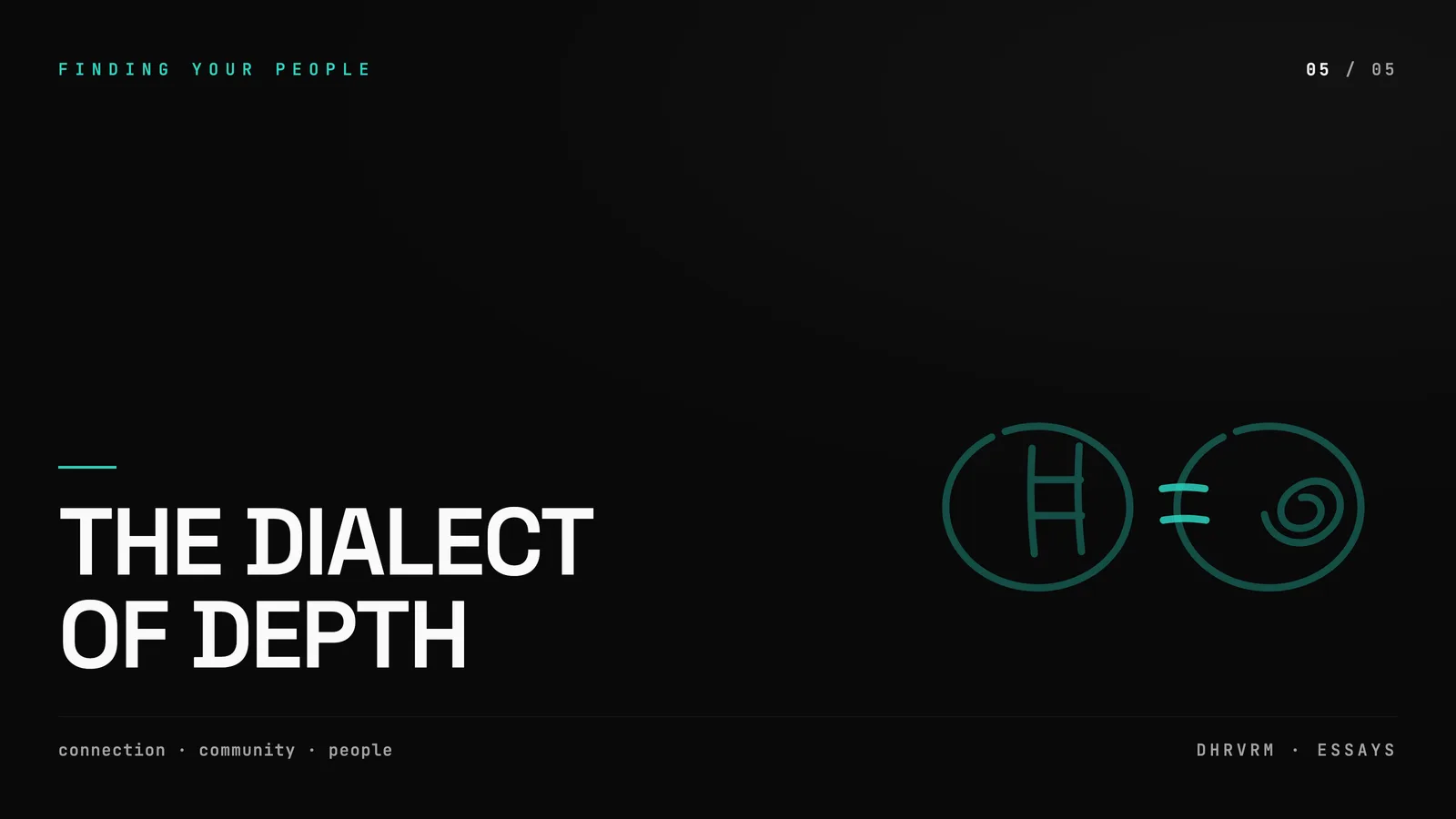
for a while i had a test for new people.
see how deep they could go on a first meeting. if they hit a wall, they weren’t my people.
it felt efficient. it even felt honest.
then a few people quietly broke the test.
a friend whose depth has never once arrived in words. it arrives as showing up, as remembering, as the exact right practical thing at the exact right time.
a person who was flat for four conversations and profound on the fifth, once something in them decided i’d stay.
the wall might be their wall. or it might be a language mismatch.
i’d been filtering for people who spoke my dialect of depth, the fast, verbal, conceptual kind, and calling everyone else shallow.
and here’s the trap in that filter. curate hard on one register and you do get a stimulating circle.
you also get a hall of mirrors. everyone descends the same way, at the same speed, into the same rooms.
i’ve done this with more than people. i did it with a whole platform.
i stepped back from linkedin because everything on it felt performative, including me. i came back only after finding a corner of it where people ran real businesses and still wrote like humans.
the platform hadn’t changed. my circle had.
it was a circle problem, not a platform problem. the depth test was the same mistake wearing different clothes.
there’s a sadder word from the same 1973 research that gave us the onion, and almost nobody tells its story.
altman and taylor called it depenetration. closeness running backwards.
when being close starts costing more than it gives, people re-cover their layers, one by one. two people who once knew each other’s bedrock become polite strangers.
intimacy is not a ratchet. it has to be maintained in whatever dialect it was built.
which is maybe the strongest argument against my old test. a circle built on one register has exactly one way to stay close, and exactly one way to fall apart.
there’s an old vedantic idea i keep coming back to here. that connection isn’t an exchange between two selves at all, but a kind of recognition. one self briefly remembering it was never two.
i don’t know if i believe it literally. but it matches something i’ve felt in the best conversations, that the boundary got thin.
and if connection is recognition, then dialects stop being obstacles. every register someone speaks is one more place recognition can happen.
so, the softer test i use now.
not “how deep can they go tonight.” but “what language does their depth speak, and have i bothered to learn a word of it.”
think of one person you quietly wrote off as shallow.
maybe they never had a ceiling. maybe they had a dialect, and you never learned it.
keep reading
start a series
more like this
something different
if this one landed, send it to someone.
Dhruv Verma
Product engineer building reliable products, mentoring builders, and learning through travel and collaboration.